The What What?
The title threw me a little…I didn’t get it, until he explained it in the book. The ‘edge‘ is how you feel when you’re at your best, mentally and physically. It’s where we all want to be, health-wise.
Dr. Who?
Dr. Braverman graduated from the New York University Medical School, and then continued his studies on the brain at Harvard Medical School and the Princeton Brain Bio Center. His interest was piqued by some studies done by his mentor, Dr. Pfiefer, that linked psychological problems and hypertension to nutrition and diet ***based on how nutrition and diet affected brain health***.
Pay No Attention to the Man Behind the Curtain!”
According to Dr. Braverman, brain health has a ‘global impact’ on overall health.
The Edge Effect Book Review: Part I
Part I of the Edge Effect gives you a ‘tour’ of the brain, and outlines it’s function as the ‘electrical circuit box’ to the body. When you plug in a lamp, the circuit box in your home provides power to make the lamp function.
In the same way, the human brain transmits the energy and electrical signals that supply power to the whole body, so that all of the organs, muscles, and cells work together as a healthy and whole living unit.
Just as the lamp plug is the ‘connection’ between the appliance and the power source, we also have a point where the body ‘connects’ with the brain. This is what he considers ‘the edge’…when the connections are functioning, we are working in harmony. When they are not functioning properly, we begin to experience ‘shorts’ in our wiring.
Our ‘wiring’ happens to be called the nervous system…it’s made up of the spinal cord, and nerves. The nerves are made up of individual nerve cells, called neurons. What’s amazing is, that the nerve cells don’t actually touch one another…and that’s part of the incredible design. Each of us has an intricate network of over 100 trillion synaptic gaps.
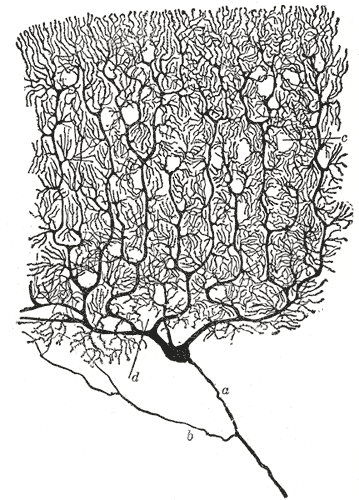
a single neuron
Let me just repeat that…the masses of nerves that run your body do not actually touch one another at all…the nerve synapses are where they communicate and send messages from one cell to the next. AMAZING.
These tiny, yet critical spaces between each nerve cell allow the ‘flow’ of electrical messages too and from the brain throughout our bodies in a coordinated, controlled and precise manner. This is where the ‘connections’ that I was just talking about take place. Below is an illustration of nerve cells sending a message through electrical impulses, with the insert showing a magnified synaptic gap, or synapse.


Meet the Cast
See the little red bouncing balls in the illustration above? Those guys are neurotransmitters, and THIS is where things get interesting. Within each of the synaptic gaps, there is a supply of four key electrochemicals that ‘ferry’ the messages across the gap.I’ll be brief here, because I’ve been so wordy above, but the neurotransmitters are created in the brain (each one is created in a different lobe or area of the brain).
The neurotransmitters you are dominant in basically lay the groundwork for your nature or personality. Seriously. The neurotransmitters are responsible for your inborn ‘nature’.
Here are the 4 primary neurotransmitters, and what they do:
Dopamine
Dopamine gives you power/drive, focus, motivation, metabolism, and regulates blood pressure and digestion.
Acetylcholine
Regulates brain speed, sensory processing, smooth thought processes. Acetylcholine dominant people are feeling based thinkers, empathy/sensitivity, have good coordination. Acetylcholine also lubricates the nervous system, and are a building block for myelin (the coating that protects and prevents ‘shorts’ in the nerves).
GABA
GABA stands for Gamma AminoButyric Acid. It is stabilizing/calming, inhibitory, and ensures rhythmic brain waves. GABA dominant people are dependable, schedule oriented, objective, and highly value organization.
Seretonin
Regulates sight and the production/output of all other neurotransmitters. Serotonin provides a sense of healing, nourishing, satisfied feelings to the whole body, and allows you to rest/regenerate at night. Serotonin dominant people are palayful, realist, also enjoy great coordination. They are drawn to challenges and play, and love excitement and parties.
The Fun Part of the Book: The Quizzes!
The Edge Effect lays a LOT more ground work about the brain and personality, but if you’d like a quick look at your potential dominant nature, then you may want to try this quiz: the Braverman Nature Assessment
My husband and I took the quizzes on a road trip over the holidays. Essentially, you count up all of your True answers at the end of the test. Allow me to save you a lot of time and paper and brain cells:

After learning your basic personality balance, the next quiz in the book shows you which of the neurotransmitters you may be deficient in. Click here for the deficiency quiz, on Dr. Braverman’s PATH medical center website.
While there is some ‘crossover’ in the symptoms of one or more deficiencies, one of the fascinating things that Dr. Braverman has discovered is that a deficiency in any one of the neurotransmitters affects the body and organs in a precise and unique way.
Repairing this deficiency through diet, supplements, and lifestyle/exercise choices that support the neurotransmitter(s) that you’re deficient in can address these symptoms, which can restore positive health.
Our traditional American healthcare system, on the other hand would ‘see’ each symptom as a separate and unrelated issue that requires medication…oftentimes signing up the patient for the ‘prescription merry go round’ that does not actually address the underlying causes for declining health.
What Next?
After taking the quizzes, my husband and I both felt that we’d been ‘pegged’, and a certain sense of hope and relief that the symptoms we had puzzled about in ourselves were not just random and unfixable ‘fluke’ problems that had previously been explained away with vague answers like ‘age’ and ‘stress’. We were ready to address the problems stemming from our deficient neurotransmitter levels.
The Edge Effect Book Review: Part II
Part II of The Edge Effect is a thorough look at each one of the four natures.
Braverman addresses each nature in even more depth, as well as common illnesses and health/memory/focus issues. He follows a typical ‘case study’ in each chapter, with a patient who is experiencing the ‘domino effect’ of a decline in their health, and shows how these problems stem from a deficiency in their primary neurotransmitter ‘nature’.
He then follows them through to the resolution of symptoms by increasing their neurotransmitter output. Each chapter also outlines ‘friendly’ medications for that biochemical, for cases where medication is needed, because a health issue is preventing you from making progress in your recovery.
Some medications support certain deficiencies better than others, so he outlines good fits. I love it that he is open to medications, but mainly as a ‘patch’ to get the patient to a point where they are able to recover their neurotransmitter levels through specific supplements, diet changes, and exercises.
Diet
When I say ‘diet’ here, I don’t mean the ‘weight-loss-through-calorie-counting’ kind.
One of my favorite parts of the book are his descriptions of how certain nutrients support specific neurotransmittters for better brain health.
Each kind of neurotransmitter is made up of unique protein building blocks, called ‘amino acids’, and these are the raw elements that our bodies *need* to create these vital chemicals that regulate our health and mood.
Including foods in your diet that are rich in the specific amino acids is very beneficial to rebuilding healthy levels of your deficient neurotransmitter. I found the food lists to be very practical and intriguing, though I would have enjoyed an even more comprehensive list of foods and herbs (which he mentions only briefly in the supplement recommendations).
There is also a sample three day diet to help you envision what it would look like to eat in the way he prescribes. Braverman suggests that food choices alone are generally not sufficient to turn the tides of a moderate to severe deficiency. So diet should usually be paired with amino acid supplementation and other supportive therapies.
Hormones
The role of hormone balance is also addressed in a fascinating way that I’d never heard before.
Each neurotransmitter has a family of hormones associated with it, that move in to ‘bolster’ the body when the neurotransmitter becomes deficient. If a deficiency in a neurotransmitter remains un-addressed, and the hormones are leaned on too heavily, this creates hormone imbalances in the body. This eventually leads to ‘burn out’ of the adrenals if it goes unchecked.
For instance, dopamine, the ‘go getter’ neurotransmitter is related to cortisol, the ‘fight or flight’ hormone. When the body is low on dopamine, it ratchets up cortisol production to provide you with the energy to keep going. This type of emergency balancing act by the body does NOT provide a sense of wellness, but at least you’re still on your feet, right?
Seretonin is related to progesterone, and so on. These hormones naturally decrease as we age, anyway, but running on a constant deficiency will burn you out much faster. Dr. Braverman suggests that hormone levels, and replacement therapy should be overseen by a medical professional.
And More…
Certain types of exercises are recommended for each nature, as well as positive lifestyle changes. He also includes a chart of supplements and dosages that may be used to correct a mild, moderate, or severe deficiency. Braverman mentions his unique supplement blends, which I finally located, at his website: here.
The Edge Effect Book Review: Part III
But What If I’m Already Sick?
The Edge Effect covers a variety of states of imbalance, including illnesses, the general ages and systems that begin to fail (the cascade effect), as well as addressing overall dietary and theraputic ways of regaining balance and prolonging optimum health.
Many specific states of disease are discussed, as well as potential treatments and therapies that are beneficial. There is also a very helpful section on personality balancing that covers how a person may see themselves, and how others may perceive them.
Conclusion
Overall, I give this book very high marks. It’s one of the most eye opening reads on overall health that I’ve come across, and I highly recommend it to anyone who is interested in combining alternative and traditional medical care, or who is looking for answers for seemingly unrelated mental/psychological and physical symptoms.
A few other Edge Effect links and articles:
Dr. Braverman and the Edge Effect interview, Douglas Labs Newsletter. Spring, 2005
When the Brain Goes, So Goes Your Health, Dr. Eric Braverman, the Huffington Post. March 16, 2009
An alternative ‘deficiency’ quiz.
So, what do you think? Is this mind blowing to anyone else?
If you’d like to own a copy of the book, I bought mine through Amazon.com for $10.36 with free shipping, here:
So cool! I started taking some suppliments via The Mood Cure (it’s awesome if you haven’t read it yet). GABA was my favorite and put me in my happy place, even though I thought I needed others more, by description. Now I see I have the GABA personality traits. Hmm!
I have read the Mood Cure, and would like to review it here at some point. I think it’s a very practical book at laying out a protocol to address mood disorders. However, this one is a lot more in depth, and is VERY information rich…they’d be great companion reads! 🙂
Just ordered it via your link. 🙂
Thank you, Andrea! Hope you enjoy it! I need to update this article with my own testimony, as well as a girlfriend who used this book to recover from a severe case of postpartum depression.
Gwen – this is very helpful. I will take the tests. I appreciate your review, and would love to read a follow up to see how making the changes has helped you.
Hi Gail! My husband and I adapted a supplement plan from this book as well as a book called the Mood Cure, which is very similar, but laid out to really help you outline a plan of action.
We both saw major improvements, and didn’t need the supplements past about 6 weeks, with making the dietary changes.
My husband’s issues cleared, but I still had other health challenges…but I still see great benefit in using this therapy for acute problems with mood, sleep, etc.
GABA changed my life